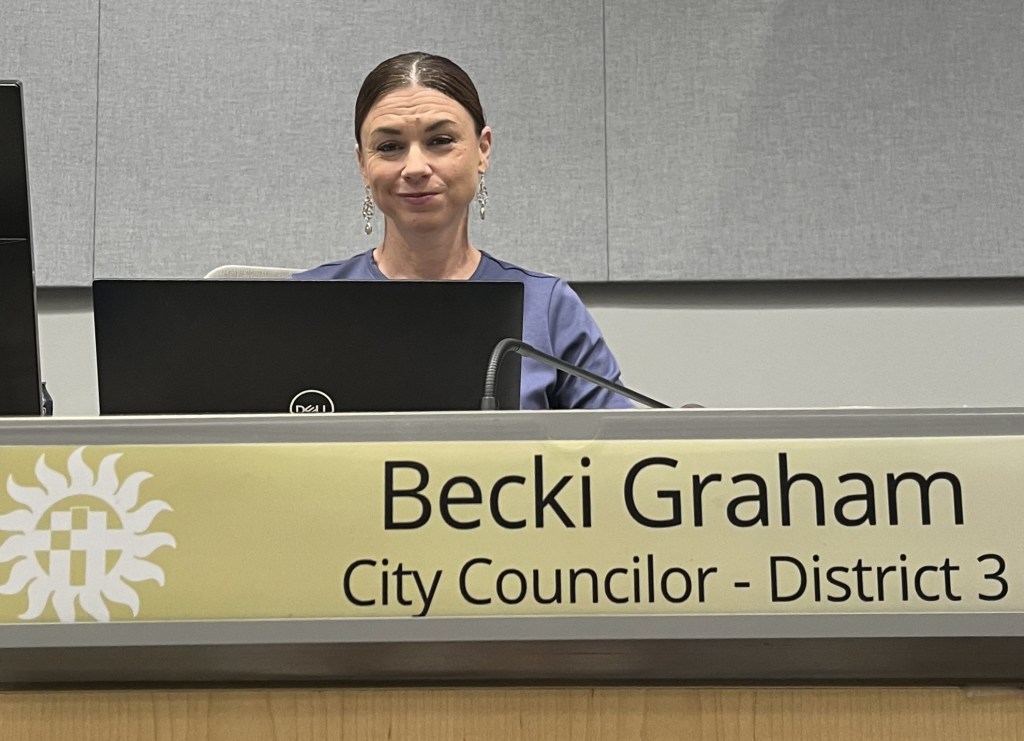
As she recuperated from a serious bike accident in 2019, competitive cyclist Becki Graham found herself wondering what her next move might be.
“I decided that 2020 would be the year I figured it all out,” she said. “Big joke on me on that one!”
During the lockdown, Graham watched her husband, a firefighter/EMT, considered an essential worker at that time, and found herself “hungering’ for a more meaningful role in the community. Overall, she was happy with how Las Cruces was ran; she would not have entered the city councilor race on her own. Learning that her district’s councilor was not going to seek re-election, she felt an opportunity had presented itself and decided to campaign for the spot.
Graham won District 3 over her two opponents, with 52% of the vote. With her win, that of Becky Corran of District 5, and of incumbent Yvonne Flores of District 6, the city of Las Cruces was set to have its first all-woman city council.
Women had previously served the city throughout the years. An old newspaper clipping cited “Marianne Thaeler, a housewife,” as the first woman commissioner ,as they were called then, in 1974. However, historical records show a Mrs. E.C. Wade served as a city commissioner from 1932-34.
In the manager’s office in the Las Cruces City Hall, two opposite walls display photographs. On one wall hang pictures of the current and mayors.
“It’s definitely interesting,” Becky Corran said of that space. “This wall of male mayors; we have never had a female one.”
On the other wall hang the pictures of the six women helping run the city.
There is a vast range of backgrounds, perceptions, and experiences, Graham said of the current city council, which is also majority women of color.
That historic moment was not without controversy.
Media coverage followed. Then the messages. Someone questioned why the council’s gender was the focus of stories.
“That press really seemed to set some folks off. I received emails and saw social media content that got quite ugly. A common theme was ‘You all think you’re so special, but you’re not,’” Graham said, recalling correspondence.
Then there is the male constituent who referred to some councilwomen, Graham included, by their first names. An instance in which Councilwoman Abeyta of District 2 took to remind meeting attendees of the protocol expected.
And there’s the male constituent who called the all-woman council the “hen house” and referred to Mayor Pro-Tem Kasandra Gandara of District 1 as “Mom” and the other councilwomen “her little kids.”
It is not surprising as Neil Harvey, professor and academic department head of government at New Mexico State University, said that sexism remains a challenge for women in political spaces. Overt or not, some people still have negative reactions to women in public affairs, he said.
Harvey added that it is a problem that needs to be addressed, but it is still important for women to have governing roles.
“We want to see government reflect everyone in society, not just one gender, or a historically- biased male perspective and representation,” he said. “There is a societal desire for greater representation to those who have been denied that for so long.”
Currently, according to the Center for American Women and Politics, women hold 30.5% of municipal governing positions in U.S. cities with populations over 10,000. The percentage, however, includes not only councils and commissions but mayoral positions as well.
“Any and all groups who have historically been left out of power-conversations need to be included as we shape the future of law and policy,” Graham said. “The more we can have a variety of lived experiences, the better off we’ll all be.”
Serving on the council has not been quite what Graham expected. She entered the position with “a lot of naivete.”
“There is such a fine balance between being respectful, deferential, to the formalities of the proceedings and being silenced. I’m doing much better at finding that balance,” Graham said.
She has learned how to act under Robert’s Rule of Orders, learning, she said, “when I could speak, when I should speak, how I might speak.”
Graham is determined, though, that whatever she says will always come from her heart. But in her so far eight-month tenure, she said she has moved to a framework of governance that is more pragmatic.
“While part of my role as a councilor is to advance ideals, to be a dreamer, I’m far more cognizant of what it takes to realize these things on a day-to-day basis. One of the last things I want is to make statements or promises from the dais that unduly burden the folks who have to actually make things happen,” she said.
Graham stated that she cares about the whole community but is willing to fight for what her district needs.
District 3 is one of the more “economically distressed” areas in Las Cruces, according to Graham. As the city grows and there is new development, she works to make sure the council doesn’t forget to take care of what it already has. Though the council is, she said, “an extremely collaborative one”—even if at their first budget meeting, it was akin to the “Hunger Games,” Graham said with a laugh.
One of the challenges at the moment involves an apartment complex in her district designed to combat homelessness for persons in the low-income bracket. What Graham said she is finding is that some surrounding residents conflate unhoused residents with crime in their area.
The Permanent Supportive Housing Project received some negative press, Graham stated, with the complex’s neighbors voicing their concerns. She refuses to let the negativity “make me not care.” She is coordinating with the Mesilla Valley Community of Hope, the Mesilla Valley Public Housing Authority, and the city police to provide necessary services and security to the complex residents while addressing the concerns of the complex’s neighbors. On her city page discussing the matter, Graham stated that there was commitment “to the safety, security, and quality of life of the entire neighborhood.”
Being in politics is performative, Graham said, clarifying that it is not an act, but rather being a Councilor is codified in ways that impedes on individuality.
“So much of what’s ascribed to me, particularly by the public, is based on the actions of my predecessor and his predecessors, and my fellow councilors, and so on,” she said. “It’s a tough transition!”
But Graham said, for her community, she’s doing it.
 Gwendolyn Joyce Mintz
Leave a comment